
Seattle’s waste disposal rules just got stricter, and if you’re planning a renovation, cleanout, or construction project, you need to know what changed. The city rolled out updated regulations in 2025 that affect how you sort waste, handle hazardous materials, and manage disposal on job sites.
We at Dumpster Solutions NW help property owners and contractors navigate these new requirements every day. Getting compliant isn’t optional-it protects your project timeline and your wallet.
What Changed in Seattle’s Waste Rules for 2025
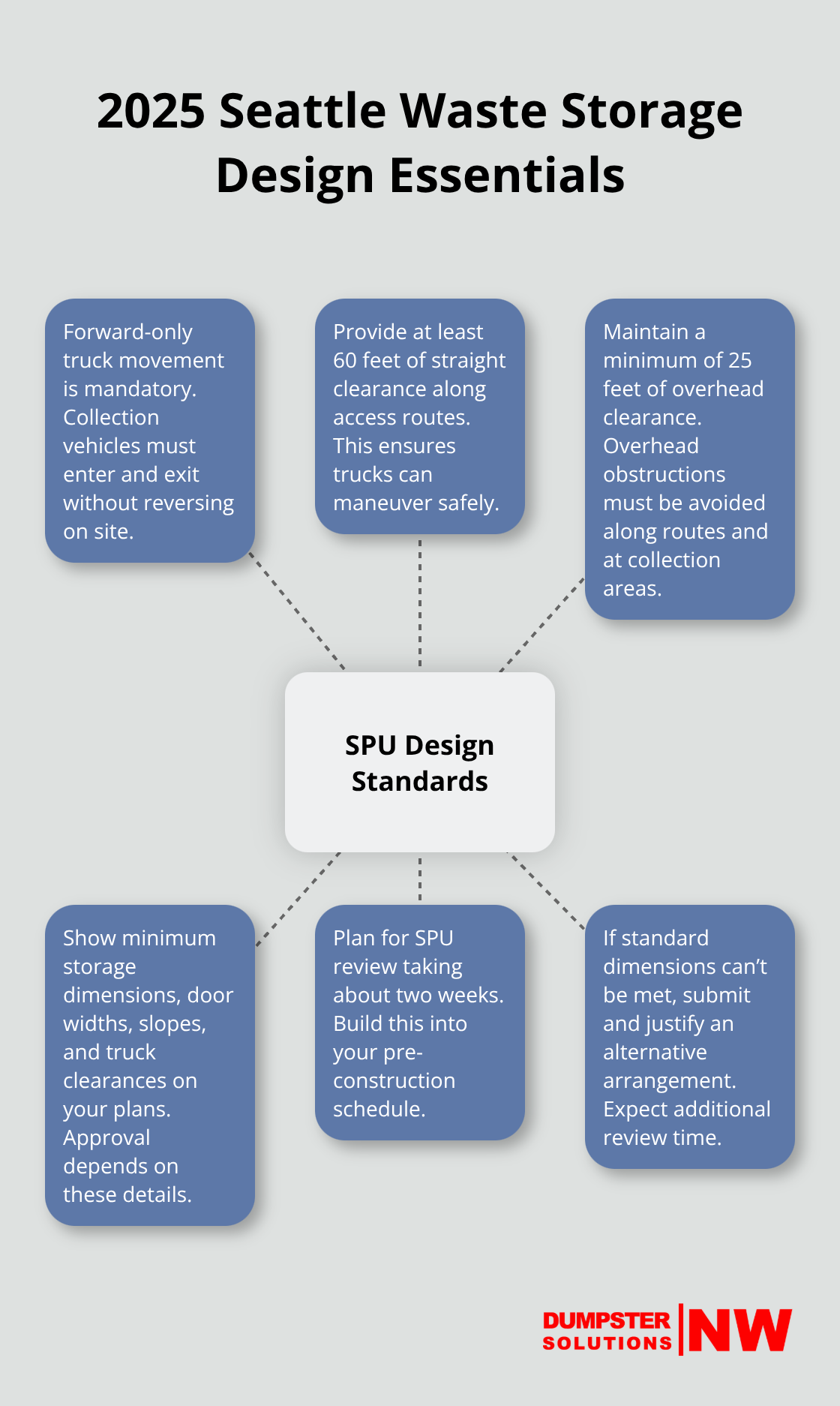
Seattle’s updated Land Use Code Section 23.54.040, which took effect October 5, 2025, fundamentally changed how waste storage and collection work across residential, commercial, and mixed-use projects. The Seattle Department of Construction and Inspections, Seattle Public Utilities, and the Seattle Department of Transportation now review all new development and major renovations under these stricter standards. The rules apply to new residential uses in Neighborhood Residential zones, commercial additions over 5,000 square feet, and change-of-use projects exceeding 10,000 square feet. The code now requires specific design details on your project plans before you break ground. You can’t estimate where your dumpster goes anymore-you must show minimum storage dimensions, door widths, access slopes, and truck clearance heights on paper first. SPU reviews these plans within about two weeks of submission, and if your design fails to meet the standards, you’ll face delays and redesigns that cost time and money. The code specifies that collection trucks must enter and exit by driving forward only, which means you need at least 60 feet of straight clearance and 25 feet of overhead clearance for access routes. If your site can’t provide these dimensions, you’ll need to request an alternative arrangement and justify why you can’t meet standard requirements.
Residential Sorting Now Has Hard Rules
Multifamily buildings must now provide three separate waste streams with no exceptions: garbage, recycling, and food/yard waste. The code specifies minimum volumes based on unit count-roughly 1 cubic yard of garbage per 10 units per week, 1.5 cubic yards of recycling per 10 units per week, and one 96-gallon cart for food/yard waste per 50 units. Loose recyclables work better than bagged materials because material recovery facilities process them more efficiently.
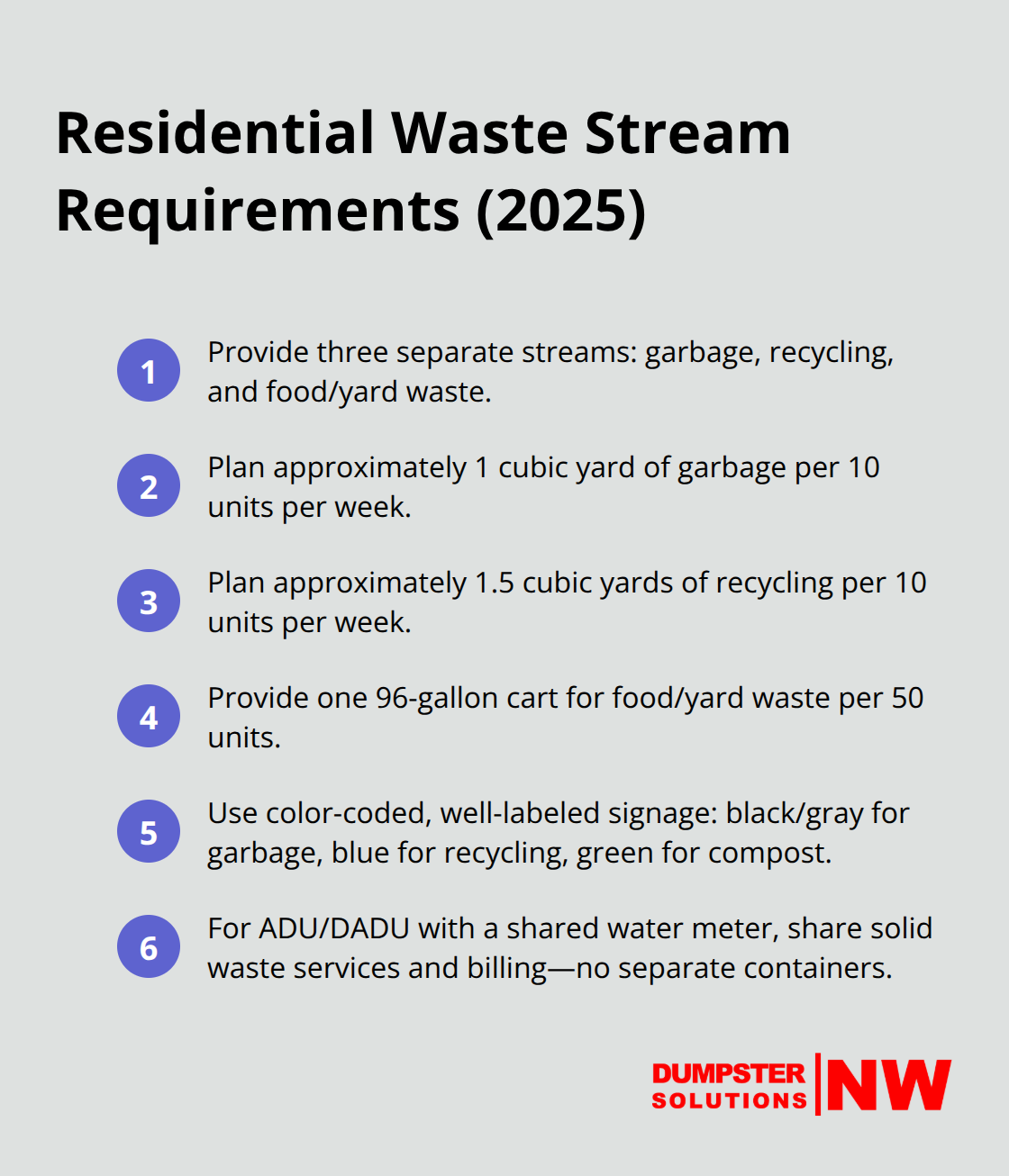
Color-coded, well-labeled signage is mandatory: black or gray for garbage, blue for recycling, and green for compost. Mixing streams results in violations and potential fines. For houses with accessory dwelling units or detached accessory dwelling units sharing a water meter, you must also share solid waste services and billing-no separate containers allowed. This rule caught many homeowners off guard because it forces shared responsibility for waste management between the primary residence and the ADU or DADU.
Commercial Projects Face Stricter Capacity Standards
Commercial and mixed-use buildings must now follow capacity requirements in SMC 23.54.040 Table A, with specific guidance for hotels, retail, and office spaces. Live-work units are treated as non-residential, meaning they require commercial-grade waste services rather than residential pickup. Chute systems, which are increasingly common in larger multifamily and commercial buildings, must now follow strict specifications: garbage chutes need a minimum 24-inch diameter, recycling chutes require 30 inches, and food/compost chutes need 24 inches. Regular cleaning and maintenance of chutes is now expected, with pressure washing and wash-down systems required to prevent odors and blockages. Cardboard processing space must be planned on each floor because corrugated cardboard is banned from garbage at several King County facilities (Bow Lake, Enumclaw, Factoria, Houghton, Renton, Shoreline, Skykomish, and Vashon). Move-in education is no longer optional-you must provide multilingual signage and materials that explain how to sort waste properly.
Hazardous Materials Face Stricter Disposal Pathways
The 2025 rules tightened restrictions on what you can throw away. Fluorescent lights and mercury-containing bulbs cannot go into standard garbage; they must be recycled at approved facilities like Bow Lake, Enumclaw, Factoria, Shoreline, or Vashon, with a limit of 10 bulbs per vehicle per day. Rechargeable batteries and lead-acid car batteries are banned entirely from solid waste facilities. Fire extinguishers, whether full or partially full, cannot be disposed of without Waste Clearance approval through King County’s process. Fireworks must be soaked in water, sealed in a plastic bag, and disposed of wet.
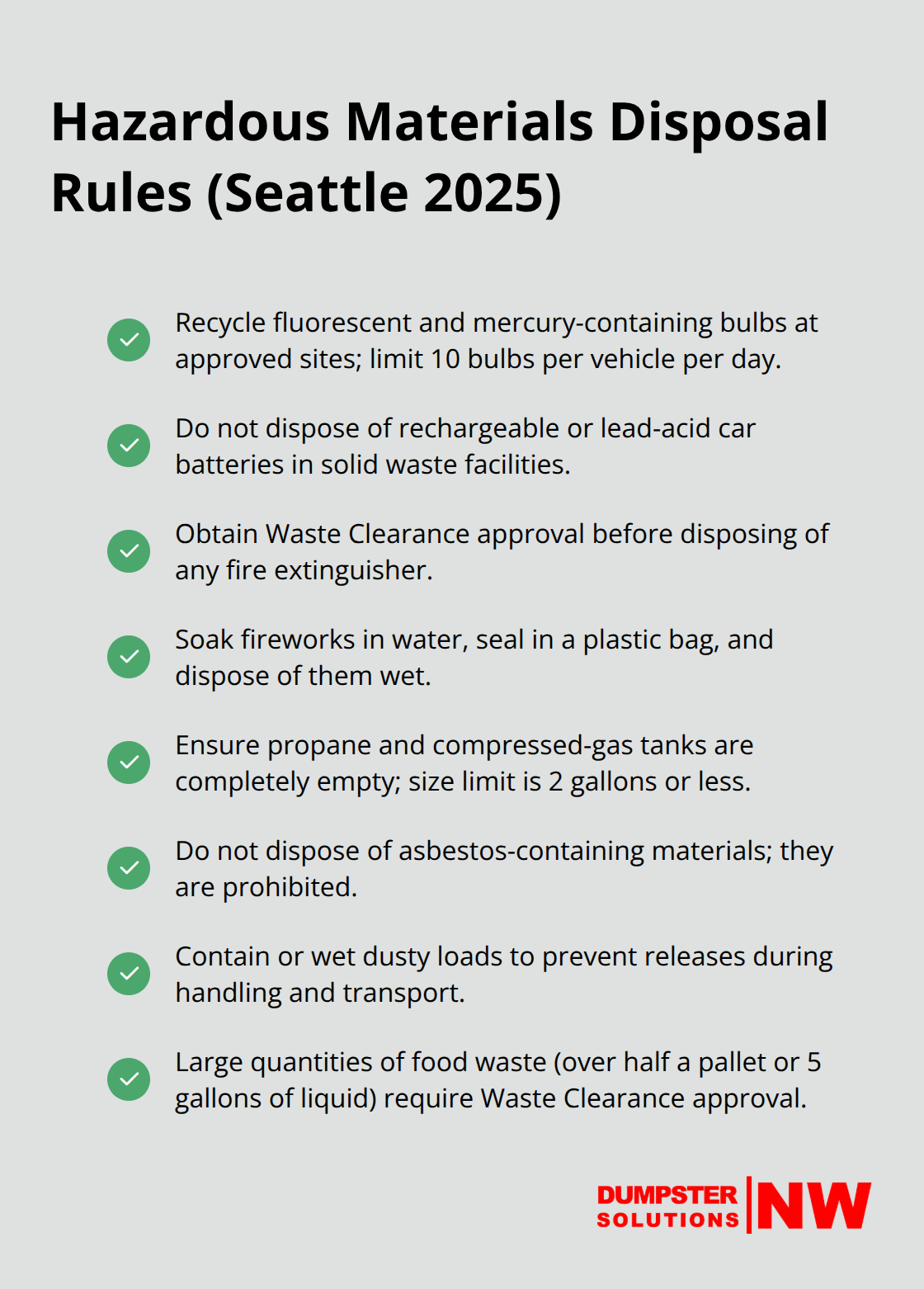
Propane tanks and compressed-gas tanks must be completely empty before disposal, with size limits of 2 gallons or less. Construction and demolition waste now requires more scrutiny-asbestos-containing materials are prohibited, and dusty loads must be contained or wetted. Large quantities of food waste (over half a pallet or 5 gallons of liquid) require Waste Clearance approval. These restrictions exist because hazardous materials contaminate landfills and water supplies, but they also mean your project timeline extends if you don’t plan disposal correctly from day one. Understanding these pathways now prevents costly delays later, which is why the next section covers how these regulations directly impact your residential projects and construction sites.
How New Regulations Change Your Project Timeline and Costs
SPU Plan Review Creates Upfront Delays
The 2025 Seattle regulations add a mandatory planning phase that didn’t exist before. SPU plan review typically takes about two weeks from submission, which means you cannot start breaking ground the day after you receive your building permit. Your waste storage design must pass separate review, and if your site lacks the required 60-foot straight clearance or 25-foot overhead clearance for collection trucks, redesigns will push your timeline back further. This upfront investment in planning prevents far costlier delays later, but it does extend your initial project schedule by at least two to three weeks.
Residential Cleanouts Now Require Pre-Sorting
Homeowners renting dumpsters for cleanouts face stricter rules about what goes into each container. If you empty a multifamily building or a house with an ADU, you must provide separate streams for garbage, recycling, and food waste-no exceptions. Mixing these streams violates city code and can result in fines or collection refusals that halt your project entirely. For residential cleanouts specifically, sorting items before they hit the dumpster takes longer than it used to. This extra labor adds time to your project schedule and may require additional dumpsters if your waste volume spans multiple categories.
Construction Sites Need Separate C&D Disposal Logistics
Contractors managing construction sites face even tighter compliance because commercial-grade waste services apply to live-work units and larger residential projects. If your site generates construction and demolition waste, you cannot throw corrugated cardboard into standard dumpsters at Bow Lake, Enumclaw, Factoria, Houghton, Renton, Shoreline, Skykomish, or Vashon facilities. These materials must go to approved C&D recycling facilities instead. This requirement alone adds a separate logistics step and potentially a second dumpster to your project budget, which contractors must account for when pricing jobs.
Non-Compliance Triggers Work Stoppages and Fines
Penalties for non-compliance escalate quickly and hit your bottom line hard. The Seattle Department of Construction and Inspections enforces violations, and violations on your project site can trigger work stoppages that cost far more than proper disposal ever would. If your waste streams become contaminated-for example, if recyclables end up in the garbage dumpster-SPU can refuse collection entirely, leaving your site unable to manage waste and forcing project delays. Construction sites that fail to obtain Right-of-Way permits for dumpster placement face fines and removal orders. For commercial projects, violations related to hazardous material disposal can result in Waste Clearance denials that prevent you from disposing of materials at all, effectively freezing your project.
Getting Ahead of Compliance Protects Your Budget
The practical takeaway is straightforward: invest time upfront in understanding your site’s waste requirements and getting your design approved before construction starts. Dumpster sizing and placement must align with current regulations to prevent costly surprises mid-project. Getting this right from day one protects your timeline, your budget, and your compliance record. The next section covers the specific practices that keep your project on track and your waste streams properly managed throughout the entire job.
How to Sort Waste and Stay Compliant
Sorting waste correctly is not optional anymore-it’s the foundation of staying compliant with Seattle’s 2025 regulations. Contamination costs money and delays projects. When recyclables end up in the garbage stream, SPU can refuse collection entirely, which means your site stops functioning. For multifamily projects, you need Seattle Public Utilities waste sorting requirements for multifamily housing with three separate streams from day one: garbage in black or gray containers, recycling in blue, and food/yard waste in green. Loose recyclables outperform bagged materials at material recovery facilities, so educate everyone on your site to avoid bagging items.
Separate Your Waste Streams Before Work Begins
For construction sites, corrugated cardboard cannot go into standard dumpsters at Bow Lake, Enumclaw, Factoria, Houghton, Renton, Shoreline, Skykomish, or Vashon facilities-these materials must go to approved C&D recycling facilities instead. This means you need a separate disposal stream planned before your first nail gets hammered. Hazardous materials require even stricter pathways: fluorescent bulbs and mercury-containing lights must go to Bow Lake, Enumclaw, Factoria, Shoreline, or Vashon with a 10-bulb-per-vehicle limit, and propane tanks must be completely empty with a 2-gallon size limit. Fire extinguishers, whether full or partially full, cannot be disposed of without King County Waste Clearance approval. Planning these disposal pathways upfront prevents project freezes that happen when you discover mid-project that your waste stream violates code.
Work with Services That Know Seattle Code
A disposal service that understands Seattle’s 2025 regulations saves you thousands in rework and delays. Your dumpster provider must understand that Right-of-Way permits are required for street placement, that SPU plan reviews take about two weeks, and that commercial-grade services apply to live-work units. When you rent from a provider unfamiliar with Seattle’s specifics, you risk getting a dumpster placed incorrectly, discovering mid-project that your waste streams don’t meet code, or facing collection refusals because your sorting doesn’t align with SPU standards. A good partner helps you right-size your dumpsters based on your actual waste volume and project type, not just a guess. They track what materials go where and coordinate with approved C&D recycling facilities when your project requires them.
Document Your Waste Management Practices
Documentation is your defense against violations and fines. Keep records of your SPU plan review submission date and approval date-this proves you followed the upfront planning requirement. Photograph your waste sorting setup before work begins and maintain a log showing which materials went into which containers throughout your project. For construction sites, document that corrugated cardboard went to an approved C&D recycling facility, not a standard transfer station. If you dispose of hazardous materials, keep receipts showing disposal at approved locations with the correct limits (for example, fluorescent bulbs at one of the five approved facilities with no more than 10 per vehicle). If your site required a Right-of-Way permit for dumpster placement, keep a copy of that permit and proof of timely renewal. This documentation takes minimal effort if you establish a system at the start, but it becomes impossible to recreate after the fact. When SPU or SDCI questions your project’s waste management-and on larger projects they will-your records prove you acted in good faith and followed code. The difference between a violation and a clean record often comes down to whether you can show that you planned properly, sorted correctly, and used approved facilities.
Final Thoughts
Seattle’s 2025 waste disposal regulations demand that you plan differently than you did in 2024. The updated Land Use Code Section 23.54.040 requires upfront planning with SPU design reviews, mandatory three-stream sorting for residential projects, stricter hazardous material pathways, and separate logistics for construction and demolition waste. Violations trigger work stoppages, collection refusals, and fines that cost far more than proper planning ever would.
Contractors and homeowners who succeed under these new rules invest time upfront understanding their site’s specific requirements and maintain documentation throughout their project. A single contaminated waste stream can freeze your entire site, and a dumpster placed without a Right-of-Way permit can be removed and fined. Getting your waste design approved before breaking ground protects your timeline, your budget, and your compliance record.
We at Dumpster Solutions NW help property owners and contractors navigate Seattle disposal requirements every single day. When you rent a dumpster from us, you work with a partner who understands SPU plan review timelines and can help you right-size your dumpsters based on your actual waste streams (we offer 10, 20, 30, and 40-yard options with transparent pricing and same-day or next-day delivery across the Seattle and Puget Sound region). Visit Dumpster Solutions NW to get started on your project with a partner who understands the rules and gets you compliant from day one.