
Picking the wrong dumpster size wastes money and creates headaches. Too small, and you’re paying for extra pickups. Too large, and you’re throwing away cash on unused space.
We at Dumpster Solutions NW created this dumpster size guide to help you match your project to the perfect container. The right choice depends on what you’re throwing away, where you’re putting it, and how long you need it.
Which Dumpster Size Fits Your Project
A 10-yard dumpster works best for small residential cleanouts like garage purges, attic decluttering, or minor bathroom renovations. These containers measure roughly 14 feet long by 7.5 feet wide by 3.5 feet high and hold about three pickup truck loads of material. They’re ideal when you’re dealing with lighter household items, old furniture, or general junk. However, if your project involves heavy debris like concrete, dirt, or asphalt, a 10-yard rock box becomes your only option due to Seattle’s strict weight transport limits. Many homeowners underestimate how quickly a 10-yard fills up with bulky items like drywall or insulation, so honest assessment matters here.
When 20-Yard Dumpsters Make Sense
The 20-yard dumpster is the workhorse for most residential renovations across the Seattle and Puget Sound region. At 22 feet long, 7.5 feet wide, and 4.5 feet high, it holds roughly six pickup truck loads and handles large kitchen remodels, full bathroom overhauls, and whole-home cleanouts without breaking a sweat. This size strikes the right balance between capacity and cost, which explains why contractors and homeowners choose it more than any other size. A 20-yard works particularly well for roofing projects-it can hold 30 to 40 squares of shingles comfortably. If you’re removing old flooring, cabinets, and fixtures from a significant renovation, this is your sweet spot.
30 and 40-Yard Dumpsters for Major Work
When construction or demolition projects scale up, you need serious capacity. A 30-yard dumpster measures 22 feet long, 7.5 feet wide, and 6 feet high, holding about nine pickup truck loads of material. This size handles large commercial debris, extensive home renovations that span multiple rooms, or significant demolition work. The 40-yard dumpster represents maximum capacity at 22 feet long, 7.5 feet wide, and 8 feet high-roughly 12 pickup truck loads-and dominates large commercial construction sites and major remodeling operations. Weight limits still apply, so heavy materials like concrete or brick may require multiple smaller dumpsters rather than one large one.
Matching Capacity to Your Actual Needs
The right dumpster size depends on three factors: the type of debris you’re removing, the total volume of waste, and your site’s physical constraints. Underestimating volume leads to overflow and extra fees, while overestimating wastes money on unused space. Heavy materials demand special attention-concrete, brick, and dirt fill dumpsters quickly and hit weight limits fast. Bulky items like old appliances, furniture, or drywall take up surprising amounts of room, so factor them in carefully when you calculate your needs.
What Really Matters When Picking Your Dumpster Size
Weight Limits Determine Your Material Options
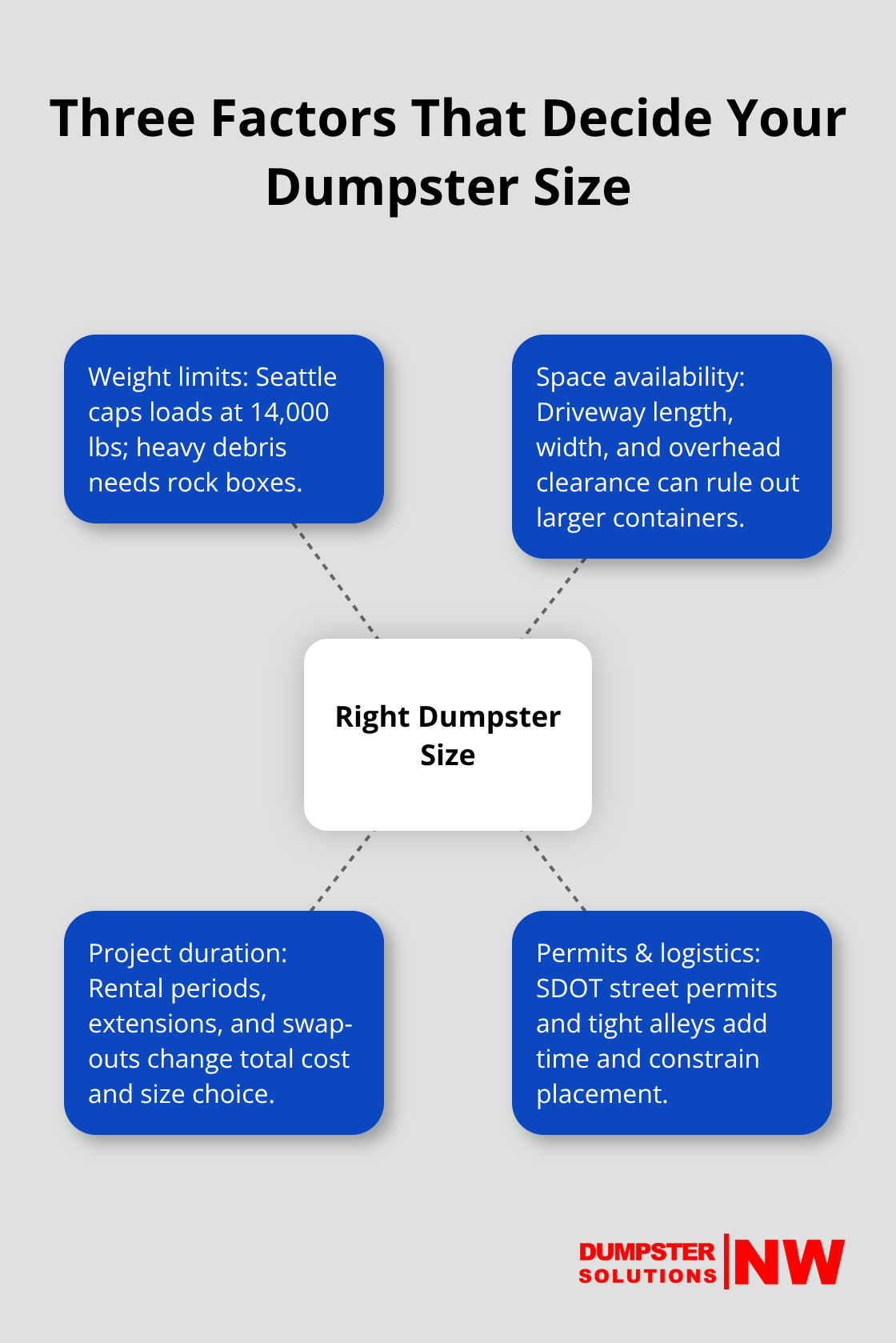
Weight limits are the non-negotiable constraint that most people ignore until it’s too late. Seattle’s transport regulations cap heavy debris loads strictly-concrete, asphalt, brick, and dirt fill dumpsters fast and hit weight ceilings faster. The maximum allowed weight is 14,000 lbs due to safety concerns, and if the container weighs more, it will be off-loaded at your expense.
This matters because heavy materials require dedicated rock boxes, and mixing them into standard dumpsters creates compliance problems and surprise fees. If your project involves demolition or site prep with substantial concrete or earth removal, plan for multiple smaller dumpsters rather than assuming one large container will work. The material type determines your dumpster selection before capacity ever enters the conversation-get this wrong and you’ll pay penalties or redo the entire haul.
Space Availability Shapes What’s Actually Possible
Space availability at your property shapes what’s actually possible, not just what’s ideal. A 40-yard dumpster measures 22 feet long and 8 feet high, requiring 100 feet of clear length for safe drop-off and pickup in Seattle. If your driveway is shorter or narrower than 7.5 feet wide, that 40-yard becomes impossible regardless of your project’s size. Overhead clearance matters too-tree branches, power lines, and building overhangs need roughly 16 feet of clearance above the dumpster. Street placement requires an SDOT permit and complicates logistics significantly, adding days to your timeline and costs to your budget. Alley placement rarely works in Seattle neighborhoods due to width restrictions and city regulations. Assess your actual placement location before you call in an order (measure your driveway width, check for overhead obstacles, and confirm level ground free of soft spots or debris). This five-minute reality check prevents expensive complications and delays that derail project schedules.
Project Duration Affects Your Total Cost
Project duration directly affects your total cost and rental selection. Standard rental periods run seven days, but extensions beyond that week incur daily fees that accumulate quickly on longer projects. A kitchen remodel lasting three weeks costs substantially more than the base rental if you keep the dumpster for the full duration. Alternatively, schedule a mid-project swap to an empty-and-return service-you swap a nearly-full dumpster for an empty one, resetting your timeline without extending rental costs. Construction timelines in the Seattle area average 4-6 weeks for significant renovations, so plan your dumpster pickups around actual completion dates and save hundreds of dollars compared to guessing. If your project stalls due to weather, permits, or contractor delays, that sitting dumpster becomes expensive dead weight. Coordinate your dumpster delivery with your actual start date rather than order early (precision scheduling beats early planning when it comes to managing rental costs effectively).
How These Factors Work Together
These three factors-weight limits, available space, and project duration-interact in ways that catch people off guard. A heavy demolition project on a tight residential lot with a short driveway might require three separate 10-yard rock boxes delivered on staggered schedules rather than one large dumpster. A kitchen remodel on a street-parking-only property needs permit coordination and timing that extends your planning window by a week. Understanding how material type, physical constraints, and timeline intersect helps you avoid costly mistakes and keeps your project moving forward smoothly.
Avoiding Common Sizing Mistakes
Underestimating Waste Volume Costs Real Money
Most people underestimate their waste volume, and that single miscalculation costs hundreds in extra fees or wasted rental space. You think your kitchen remodel will fill a 20-yard dumpster, but removing old cabinets, countertops, flooring, and drywall takes up far more room than expected because bulky items compress poorly and create air gaps. A standard pickup truck bed holds 2 to 3 cubic yards, so a 20-yard dumpster equals roughly 6 to 8 truck loads-yet homeowners routinely guess wrong because they visualize the waste as stacked neatly rather than loosely piled as it actually arrives.
Photograph your project space and estimate every material type separately (old flooring, wall debris, fixtures, packaging). Add 30 percent for unexpected finds you’ll discover once work starts. If you’re removing an old kitchen, plan for at least 20 yards minimum; if you add a bathroom remodel to that same project, jump to 30 yards. Underestimating volume leads to mid-project complications, which cost more than ordering the right size upfront.
Weight Restrictions Destroy Projects More Frequently Than Capacity Constraints
Weight restrictions destroy projects more frequently than capacity constraints, yet people ignore them until the hauler refuses to pick up the dumpster. You cannot mix heavy materials like concrete, brick, asphalt, or dirt with standard household debris in a regular dumpster-Seattle’s transport regulations and weight limits flat out prohibit it. Violations mean your dumpster sits unpicked while you scramble to remove the offending materials manually.
The 14,000-pound weight limit applies across all standard dumpster sizes, which means a 30-yard dumpster holding dense concrete fills to weight capacity far faster than volume capacity. Demolition projects involving foundation removal, concrete patios, or extensive brick work absolutely require dedicated rock boxes. Mixing materials forces costly off-loading fees paid entirely by you. Before you order, identify your heaviest materials and confirm whether they need a rock box or standard dumpster-this five-minute conversation prevents project delays and surprise expenses that wreck your budget.
Bulky Items Take Up More Space Than You Expect
Bulky items like old appliances, furniture, and drywall take up surprising amounts of room, so factor them in carefully when you calculate your needs. A single old refrigerator occupies space equivalent to several bags of general household waste. Drywall sheets stack loosely and create massive air gaps that inflate your actual volume needs. Flooring materials, whether tile, hardwood, or carpet with padding, compress poorly and demand more dumpster space than their weight suggests.
These items (appliances, drywall, flooring) often surprise homeowners because they visualize them as compact when they’re actually quite voluminous. A bathroom remodel that seems modest on paper-remove old vanity, toilet, tile, and fixtures-actually generates enough bulk to require a 15-yard dumpster rather than a 10-yard. Test your estimate by walking through your project space and physically pointing out each item you’ll remove, then add 20 percent more capacity for safety.
Final Thoughts
Picking the right dumpster size comes down to three core decisions: matching your project type to realistic capacity, respecting weight limits and material constraints, and timing your rental around your actual completion date. A 10-yard dumpster handles small residential cleanouts and minor bathroom work, while a 20-yard tackles most kitchen remodels and whole-home cleanouts across the Seattle and Puget Sound region. A 30 or 40-yard dumpster powers large construction projects and demolition work that demands serious capacity.
Accurate assessment separates successful projects from budget disasters. Five minutes spent measuring your driveway, identifying your heaviest materials, and photographing what you’ll remove saves hundreds of dollars and weeks of frustration. Underestimating volume forces mid-project scrambling and extra fees, while ignoring weight limits creates compliance violations and surprise costs that wreck your budget.
We at Dumpster Solutions NW offer 10, 20, 30, and 40-yard dumpsters to fit any project size, with flat-rate pricing that eliminates hidden fees and surprises. Our team delivers quickly-often same-day or next-day-and handles all the hauling and responsible disposal once you finish. Contact us today through our dumpster size guide and let us handle the heavy lifting while you focus on completing your project on schedule and on budget.
Disclaimer: The information provided in this blog is for general informational purposes only and does not constitute legal, financial, or insurance advice. Coverage options, terms, and availability may vary. Please consult with a licensed professional for advice specific to your situation