
Dumpster rental pricing shouldn’t feel like a mystery. Too many companies bury extra charges in the fine print, leaving homeowners shocked when the final bill arrives.
We at Dumpster Solutions NW believe straightforward dumpster rental means exactly what it says: transparent costs from start to finish, with no surprises waiting for you.
What Hidden Fees Actually Cost You
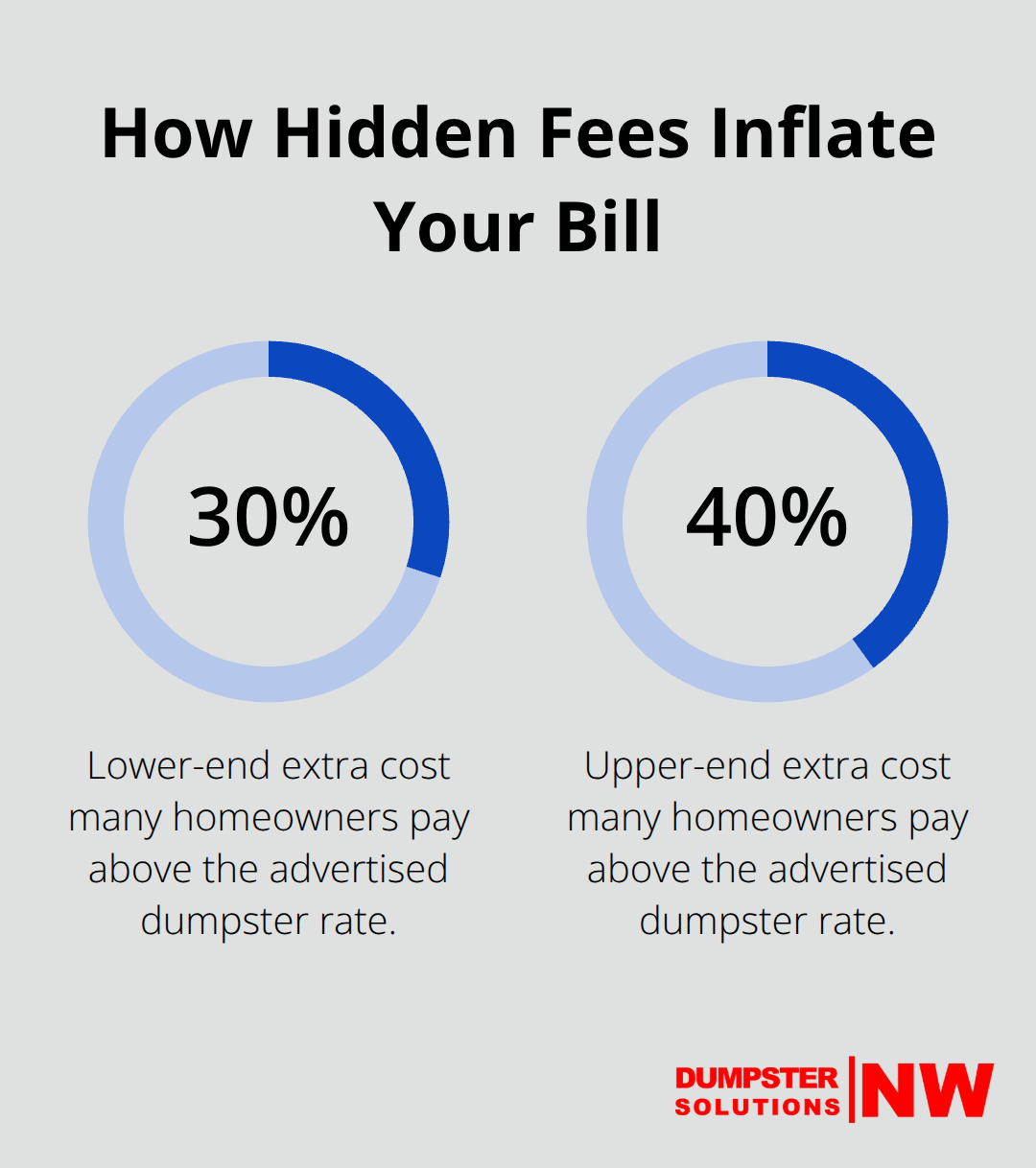
The dumpster rental industry thrives on surprise charges. SPU Solid Waste, a major Seattle-area provider, raised its monthly account fee to $51.15 in April 2026-a jump from $49.50 the previous year. But the account fee is just the beginning. Non-compacted waste pricing climbed across all container sizes in 2026; a 1-yard container went from $85.30 to $88.08 monthly, while an 8-yard jumped to $356.53. Compacted rates are even steeper, with a 1-yard compacted container hitting $424.99 in 2026, up from $411.57 in 2025. These costs stack up month after month. Beyond the base rate, special pickup charges add another layer. A 30-yard non-compacted container costs $1,200.23 per special pickup, while the same size compacted runs $2,385.83. Smaller containers aren’t spared either; a 3/4-yard non-compacted jumped from $76.01 to $78.49 per pickup. Then come the ancillary fees: $10.55 for roll-out service, $10.55 to reposition a container, and $60.65 to disconnect or reconnect a compactor. A homeowner thinking they’re renting a simple dumpster often pays 30 to 40 percent more than the advertised rate once all these extras hit the invoice.
Where the Real Damage Happens
The problem intensifies when you don’t know these fees exist. A homeowner planning a kitchen remodel calculates the base monthly rate, then discovers they’re charged for roll-out service, reposition fees, and a lock installation because their driveway requires repositioning. A contractor managing multiple pickups on a renovation project faces compacted vs. non-compacted rate differences that can swing costs by hundreds of dollars depending on material type. Waste composition matters too-heavy materials like concrete and asphalt compress differently than drywall and wood, affecting whether you pay the cheaper non-compacted rate or the steeper compacted rate. Most companies don’t explain this upfront.
How Transparent Pricing Protects Your Budget
Straightforward pricing eliminates these financial traps. When a company quotes you a flat rate, that number represents your actual cost. No roll-out fees. No reposition charges. No surprise account fees. Your quote becomes your final bill, allowing you to budget accurately and avoid the financial shock that plagues homeowners across the Seattle area, from Tacoma to Edmonds to Bellevue. This approach shifts the burden of clarity onto the rental company, not onto you.
What Transparent Pricing Actually Means
Flat-Rate vs. Variable Pricing: The Cost Difference
The difference between flat-rate and variable pricing determines whether your final invoice matches your initial quote. Variable pricing structures charge a base rate, then layer on extras like roll-out fees, repositioning charges, lock installation, and compactor disconnect fees. This means a homeowner quoted one price for a dumpster discovers the actual cost climbs significantly higher once special pickups, account fees, and ancillary charges accumulate. Flat-rate pricing eliminates this math entirely. Your quote becomes your final cost, period.
How Straightforward Pricing Works
Transparent pricing works because rental companies build service costs into the upfront quote rather than hiding them in fine print. You avoid the shock that catches homeowners off guard when they receive invoices significantly higher than expected. This approach shifts the burden of clarity onto the rental company, not onto you. Companies that offer straightforward pricing provide written quotes that match final invoices, protecting your budget from surprise charges.
Questions That Reveal True Transparency
Spotting legitimate transparent pricing requires asking specific questions before you rent. Request the total cost in writing, including delivery, pickup, and any weight limits or overage charges. Ask whether the quote covers all service calls, repositioning, or special handling. Verify whether the company charges differently for compacted versus non-compacted waste, since material type affects cost dramatically. Legitimate transparent pricing companies answer these questions directly and provide written documentation. Companies that hedge on details, quote vague base rates, or mention fees only after you commit are using variable pricing disguised as simplicity.
Red Flags in Dumpster Rental Pricing
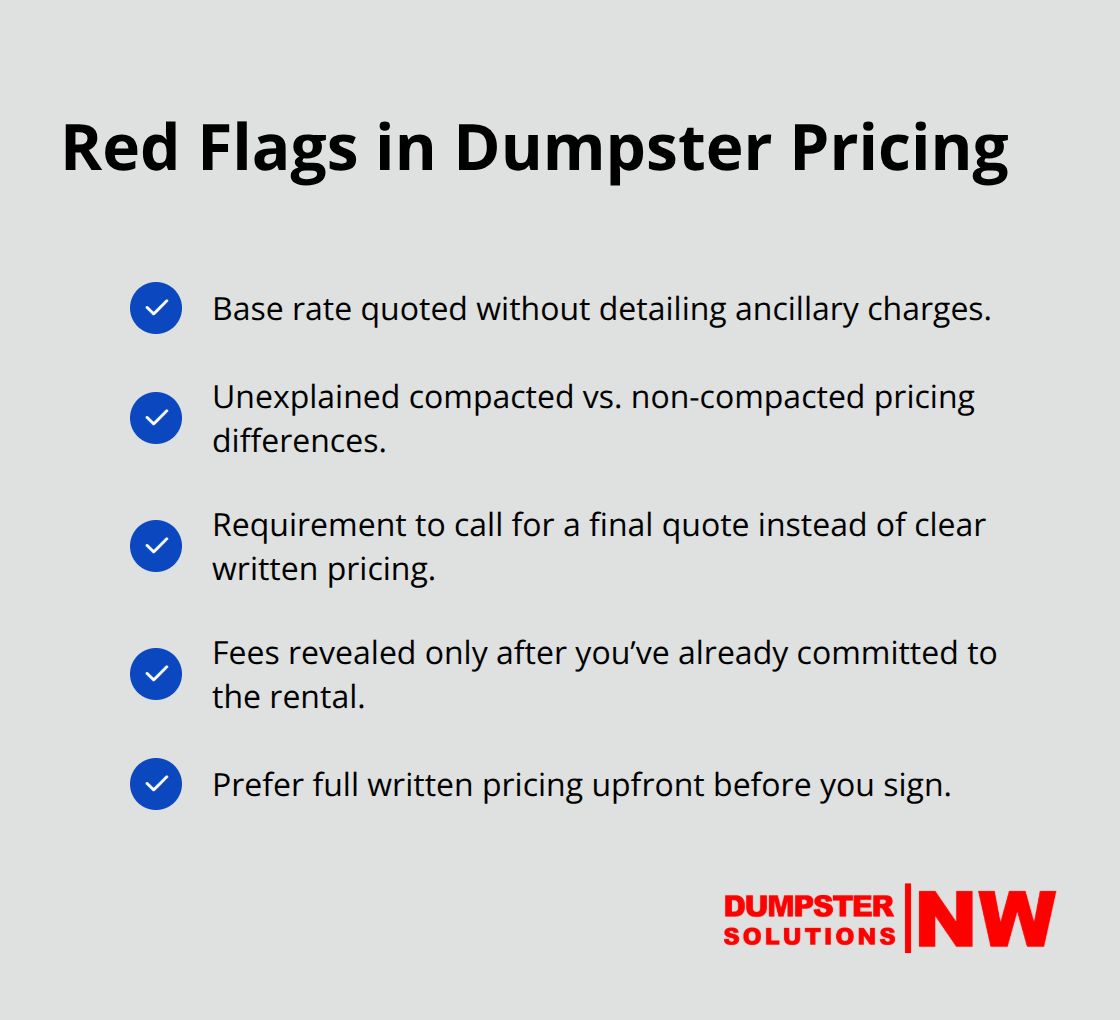
The Seattle-area dumpster rental market includes operators using both models, but the ones worth hiring provide flat quotes upfront and stand by them. Watch for companies that quote a base rate without addressing ancillary charges, those that mention different pricing for compacted versus non-compacted waste without explanation, or those that require you to call for a final quote. These tactics hide costs until you’ve already committed to the rental. Straightforward operators eliminate this uncertainty by providing complete pricing information before you sign anything.
Now that you understand what transparent pricing looks like, the next step involves matching that clarity to the right dumpster size for your project.
Pick the Right Size, Skip the Overpayment
Choosing a dumpster size without matching it to your actual waste volume wastes money in two ways: rent a container too small and you’ll pay overage fees or need a second pickup; rent one too large and you’re paying for space you never use. The difference between a 10-yard and a 20-yard dumpster matters significantly for your wallet.
Understanding Dumpster Sizes and Capacity
A 10-yard dumpster holds roughly 4 pickup truck loads and measures 15 feet long by 8 feet wide by 2 feet high, making it suitable for smaller projects like garage cleanouts, attic purges, or bathroom remodels where debris is relatively light. A 20-yard dumpster holds about 8 pickup truck loads with dimensions of 21 feet 11 inches long by 7 feet wide by 3 feet 6 inches high, handling heavier materials like concrete, asphalt, and drywall from home renovations or roof tearoffs.
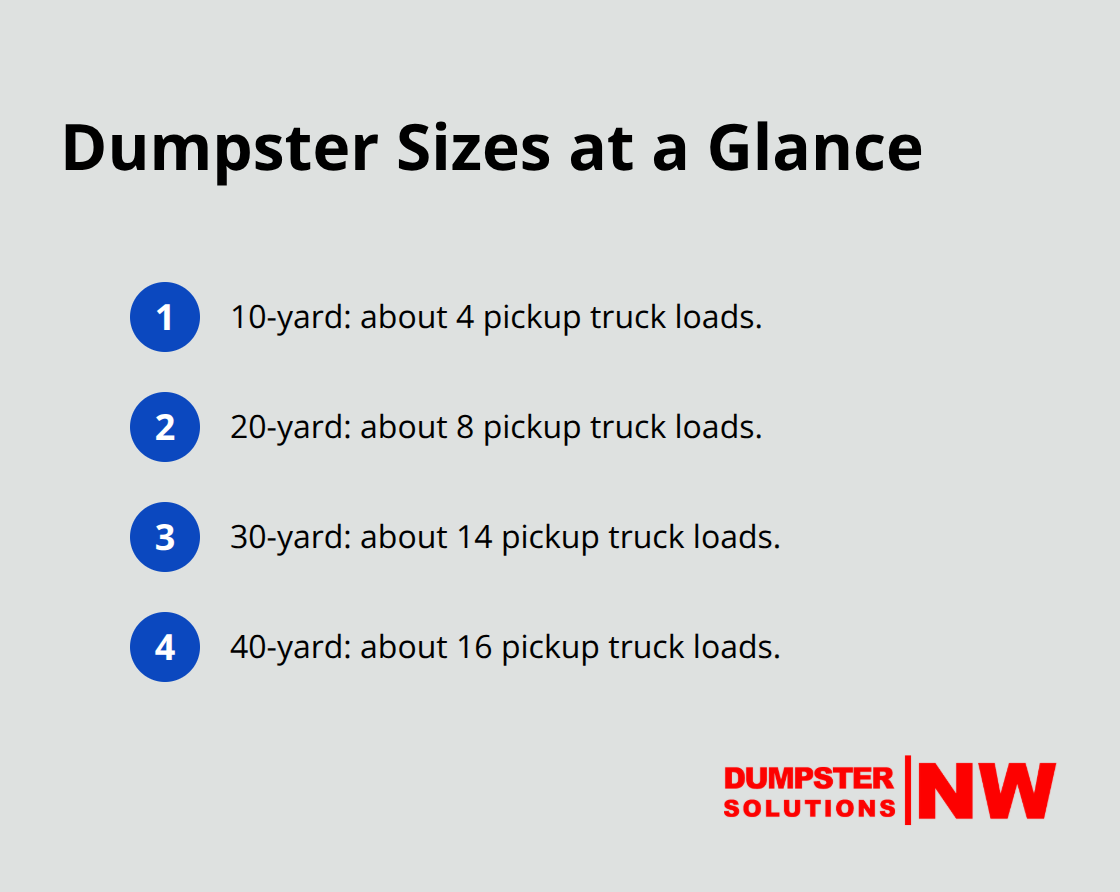
A 30-yard dumpster accommodates roughly 14 loads and works well for larger renovations, estate cleanouts, or multi-room remodels, while a 40-yard dumpster, the largest option, suits major construction projects and can handle approximately 16 loads.
The Cost of Overestimating Your Waste
Most homeowners overestimate their waste volume to avoid running out of space, then pay for unnecessary capacity. Weight limits add another cost layer; each size carries a tonnage cap, and exceeding it triggers overage charges that can run $50 to $150 per ton depending on the operator. Material composition affects weight significantly-a cubic yard of concrete weighs roughly 1.5 tons, while the same volume of drywall weighs only about 0.5 tons, meaning two projects that look similar in volume can differ dramatically in actual weight and cost.
Categorizing Your Debris Before You Call
Estimating your waste accurately requires you to categorize what you’re throwing away before you call for a quote. For a kitchen remodel, list the items: old cabinets, countertops, flooring, drywall, and appliances. Old kitchen cabinets occupy substantial space but weigh moderately, while concrete countertops are both bulky and heavy. Drywall from walls and ceilings takes up significant volume but weighs less than you’d expect. A bathroom remodel produces similar debris-fixtures, tile, drywall, flooring-but in smaller quantities, typically fitting in a 10-yard container. Roofing projects produce heavy, compact waste; shingles, plywood, and underlayment compress during transport, meaning a 20-yard dumpster handles most residential roof replacements despite the intimidating volume before disposal. Flooring projects vary by material; removing old carpet and padding from a 2,000-square-foot home fills roughly 6 to 8 cubic yards, while hardwood or tile removal adds significantly more weight and volume. Estate cleanouts and general junk removal present the hardest estimates because the contents vary wildly-furniture, clothing, electronics, and miscellaneous household items have unpredictable weights and volumes.
Getting an Accurate Quote
The practical approach involves you photographing your space, measuring the area, and describing the specific items you’re removing to the rental company. Dumpster Solutions NW helps you right-size your dumpster based on these details, ensuring you’re not overpaying for unused capacity. Asking whether the company charges differently for compacted versus non-compacted waste matters too, since heavy materials like concrete and asphalt compress during transport, potentially affecting your final bill if the operator classifies your load differently than expected. Requesting a written quote that specifies your dumpster size, the weight limit, any overage fees, and whether compaction charges apply protects you from discovering hidden costs after pickup.
Final Thoughts
Straightforward dumpster rental pricing protects your project budget and eliminates the financial stress that catches homeowners off guard. When you understand what transparent pricing actually means-flat rates with no hidden roll-out fees, reposition charges, or surprise account fees-you can compare rental companies fairly and make decisions based on real costs, not marketing promises. The Seattle-area dumpster market includes operators using both transparent and variable pricing models, but the ones worth hiring provide complete quotes upfront and stand by them without exceptions.
Choosing a dumpster rental company requires you to ask specific questions before you commit. Request the total cost in writing, including delivery, pickup, weight limits, and any overage charges; verify whether the company charges differently for compacted versus non-compacted waste; and confirm that all service calls are covered in the quoted price. Companies that answer these questions directly and provide written documentation are using straightforward pricing, while those that hedge on details, quote vague base rates, or mention fees only after you’ve committed are hiding costs.
We at Dumpster Solutions NW deliver on clear pricing because we believe your final invoice should match your initial quote. Visit Dumpster Solutions NW to get a transparent quote for your project and experience the difference straightforward dumpster rental makes.
Disclaimer: The information provided in this blog is for general informational purposes only and does not constitute legal, financial, or insurance advice. Coverage options, terms, and availability may vary. Please consult with a licensed professional for advice specific to your situation